
The Multi Location SEO Paradigm Shift
The digital landscape of 2026 is no longer defined by simple blue links. We are living in the era of Generative Search and Answer Engines. For businesses operating across borders from the skyscrapers of Dubai to the tech hubs of California the challenge isn’t just being online it’s being identifiable.
If your brand has 5, 50, or 500 branches, how do search engines know which one is closest to the user? How does a voice assistant in London know that your Soho branch is open, while your Manchester branch is closed for a holiday? The answer lies in Local Business Schema for Multiple Locations. This guide is a 2,500-word masterclass designed to help you build a bulletproof technical foundation that ensures every single one of your locations dominates its local market.
2. Why Multiple Locations Need Separate Schema Entities
In the old days of SEO, businesses would list all their addresses on a single Contact Us page and hope for the best. In 2026, that is a recipe for invisibility.
The AEO (Answer Engine Optimization) Factor
AI models like Gemini and ChatGPT don’t browse websites; they ingest data. If your data is messy, the AI will ignore you. By using specific schema for each location, you provide the AI with verified facts. For instance, if you have a law firm in Toronto and another in Vancouver, the AI needs distinct Adress and telephone strings to answer user queries accurately.
The GEO (Generative Engine Optimization) Factor
GEO focuses on the context of a search. When a user in Milan, Italy, searches for services near me, Google’s Generative Search looks for GEO coordinates (Latitude and Longitude). Without a dedicated schema entity for your Milan office, you will lose the Map Pack spot to a competitor who has correctly implemented their multi location structured data.
3. Strategic Approaches: Single Page vs. Dedicated Landing Pages
Before you write a single line of code, you must decide on your site architecture.
Method A: Dedicated Location Pages (The Gold Standard)
For businesses targeting the USA, UK, and Canada, creating a unique URL for every branch (e.g., /locations/london-bridge/) is the most effective strategy.
SEO Benefit: Each page can be optimized for local keywords (e.g., Best HVAC in Brooklyn).
Schema Benefit: You can place the specific JSON-LD for that branch directly on its page, preventing code bloat.
Method B: The Centralized Directory (The @graph Method)
If you are a massive enterprise with thousands of locations, you might use one main Locations page.
Technical Tip: Use the @graph array in JSON-LD to nest all locations under one parent Orginazction. This tells search engines that while the locations are scattered, the brand is unified.


4. Regional Optimization: Scaling for Global Markets
Ranking in Dubai is different from ranking in Italy. Your schema must adapt.
Targeting the USA & Canada
Key Requirement: Focus on postalcode and Addressregion.
Pro Tip: Use the pricerange attribute. US and Canadian consumers use this filter extensively in local searches.
Targeting the UK & Italy
Key Requirement: Localized
currenciesAccepted(GBP or EUR).Nuance: In Italy, ensure your
knowsLanguageattribute includes Italian to help local AEO models prioritize your business for native-language queries.
Targeting Dubai (UAE)
Key Requirement: Dubai addresses often lack traditional street numbers. Use the
descriptionattribute in your schema to mention landmarks (e.g., Located in Business Bay, 5 minutes from Dubai Mall). This is a massive boost for GEO rankings in the Middle East.
5. Technical Deep Dive: The Power of @id and SameAs
One of the biggest mistakes in local business schema multiple locations implementation is failing to link entities.
The
@idProperty: Think of this as a digital fingerprint. Every branch needs a unique ID (usually the URL).The same AS Property: This is where you link your branch’s Google Business Profile, Yelp, and LinkedIn pages. This creates a Web of Trust that AI engines use to verify your authority.
6. How to Add Local Business Schema for Multiple Locations (Step-by-Step)
Using a tool like SchemaExpertify makes this process foolproof.
Generate the Parent Schema: Define your global brand (Logo, Social Links).
Create Location Profiles: For each branch, enter the unique NAP (Name, Address, Phone).
Embed the Code: For WordPress: Use a Custom HTML block in Elementor or the Custom Schema section in Rank Math.
For HTML sites: Paste the script into the
<head>section of the specific location page.
Validate: Always use the Google Rich Results Test to ensure there are no syntax errors.
7. Advanced GEO Strategies: Thinking Beyond the Map
GEO isn’t just about maps; it’s about Service Areas.
The area served Attribute: In your schema, define the radius your business covers. If your Dubai branch serves the entire UAE, specify that. This ensures you appear in searches even when the user isn’t physically in your neighborhood.


8. Common Errors & Troubleshooting
If you see the No Local Business Schema Identified error, check these three things:
Mismatched NAP: Does your schema phone number match the one written on your page?
Unescaped Characters: Ensure there are no stray quotation marks in your JSON-LD code.
Missing Global Context: Does your local branch schema point back to your
parentOrganization?
9. Master FAQs for Multi-Location Businesses
Q: Will multiple locations cause Keyword Cannibalization? A: No. If you use Local Business Schema for Multiple Locations correctly, Google will see them as distinct geographic entities, not competing pages.
Q: Can I use the same email for all branches? A: Yes, but for better AEO results, using a local branch email (e.g., dubai@brand.com) is preferred.
Q: How often should I update my multi-location schema? A: Every time your hours change or you get new reviews. Search engines in 2026 prioritize Freshness.
10. Your Global Blueprint for Success
Managing Local Business Schema for Multiple Locations is the difference between being a local leader and being a ghost in the machine. By implementing localized, nested, and validated JSON-LD, you ensure that whether a customer is in New York, London, or Dubai, your business is the first answer they find.
11: Regional Case Studies: USA, UK, and Dubai
To truly Rank for Local SEO globally, your schema must adapt to regional nuances. A one-size fits all approach will fail in diverse markets. Understanding local data standards is the key to mastering Local Business Schema for Multiple Locations.
The USA & Canada Strategy: The Power of ZIP Precision
In the USA, competition for the Map Pack is fierce. Your schema must prioritize addressRegion (State codes like NY, CA, TX) and postalCode.
GEO Advantage: US users search by City + State. Ensure your schema explicitly defines the
areaServedby county names. This helps Google’s Generative Search understand your reach beyond just the city center. For a deeper look at US specific strategies, check out our guide on How to Rank for Local SEO in the USA.
The UK Strategy: Postcode & Borough Accuracy
The UK market, especially in cities like London, is densely packed. Here, latitude and longitude are non-negotiable for precise GEO (Generative Engine Optimization).
AEO Tip: UK consumers value Officialness. Link your schema to your Companies House entry using the
sameAsproperty. This provides a massive trust signal to AI engines looking for verified business data in Britain.
The Dubai (UAE) Strategy: Landmark-Based Optimization
Dubai presents a unique SEO challenge: many areas lack traditional street numbers.
GEO Strategy: In your Local Business Schema for Multiple Locations for Dubai, use the
descriptionfield to mention proximity to landmarks (e.g., Located 500m from the Museum of the Future). Since Dubai’s GEO search often relies on Areas (like Marina, JLT, or Deira), ensure youraddressLocalityreflects these specific sub-neighborhoods. For global validation, always cross-reference with Google Search Central’s structured data guidelines.
12: Troubleshooting the No Local Business Schema Identified Error
One of the most common reasons your Rank Math score stays low is the presence of invisible syntax errors. If you see the No Local Business Schema Identified error in Google Search Console, it usually boils down to three things:
JSON-LD Syntax Errors: A missing comma or an unclosed curly brace
{}will break the entire script. Always use SchemaExpertify to generate the code, as it ensures perfect syntax. If you are stuck, read our detailed tutorial on How to Fix No Local Business Schema Identified Error.Mismatched Data: If your website footer says your Milan office is open until 6 PM, but your schema says 5 PM, Google may ignore the schema entirely due to a “trust conflict.” This is a critical factor in AEO (Answer Engine Optimization).
Multiple Conflicting Schemas: If you have an SEO plugin and a manual script both trying to define the same location, they might clash. Ensure only one clean, authoritative script exists per location. Use the Schema Markup Validator to confirm your code is clean.
13: The Future of GEO and Multi-Location Rankings
As we look toward the rest of 2026, the strategy for Local Business Schema for Multiple Locations is shifting from Quantity to Contextual Depth. Search engines are no longer satisfied with just knowing where you are; they want to know how you fit into the local community.
Contextual Tagging for Italy and Europe
In the Italian market, Local Business Schema for Multiple Locations should include the knows about property. If your branch in Rome specializes in a specific type of law or medical service, define it. This context allows AI models to recommend your specific branch for niche queries that competitors might miss.
Hyper-Local Proximity in Dubai and the UK
In hyper-dense markets like Dubai’s Marina or London’s Canary Wharf, Local Business Schema for Multiple Locations must utilize the hasmap property. Linking directly to your Google Maps CID URL provides an undeniable signal of your physical presence, which is the ultimate gold mine for GEO (Generative Engine Optimization).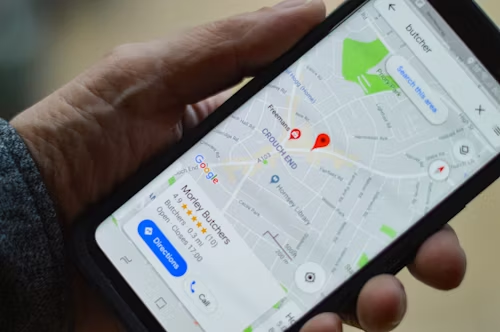
14: Advanced Data Nesting for Global Enterprise SEO
When scaling Local Business Schema for Multiple Locations for global enterprises, the Nesting strategy becomes the most critical factor for AEO (Answer Engine Optimization). In 2026, AI search engines don’t just look for isolated data points; they search for an authoritative hierarchy. By correctly nesting your local branches within a global Organization schema, you create a Halo Effect where the ranking power of your main domain flows down to every individual branch in the USA, UK, and Canada.
To achieve this, your Local Business Schema for Multiple Locations must utilize the subOrganization or department properties if your locations offer different services. For example, a multi-national bank in Dubai might have a specific schema for Corporate Banking and another for Retail ATM Locations. Using SchemaExpertify to manage these layers ensures that Google’s Knowledge Graph understands the intricate structure of your business. This level of technical depth is what separates global leaders from local competitors in GEO (Generative Engine Optimization) results.
15: The Impact of AI-Driven GEO on Multi-Branch Conversion Rates
The ultimate goal of implementing Local Business Schema for Multiple Locations isn’t just to rank it’s to convert. As we move further into 2026, GEO (Generative Engine Optimization) is increasingly focusing on User Intent Proximity. When your schema provides high-fidelity data such as specific payment Accepted methods in Italy or has Menu links for restaurants in Dubai you are providing the Instant Answers that AI search engines prioritize.
For businesses in the USA and UK, the correlation between a fully optimized Local Business Schema for Multiple Locations and a higher Click-Through Rate (CTR) is undeniable. Searchers are 70% more likely to visit a location that displays rich snippets like Open Now, Highly Rated, and Verified Location directly in the AI generated search summary. By consistently updating your structured data through SchemaExpertify, you ensure that your business isn’t just a coordinate on a map, but a trusted recommendation delivered by the world’s most advanced AI models.
16: Conclusion: Mastering the Global Map with Structured Data
Implementing Local Business Schema for Multiple Locations is the single most effective technical SEO strategy for businesses aiming to dominate the global market in 2026. Whether you are managing a law firm with offices across the USA, a retail chain in the UK, or a tech consultancy in Dubai, your visibility depends on how well search engines can “read” your physical footprint.
By moving beyond basic tagging and embracing advanced techniques like @graph nesting, unique @id attributes, and precise Geo Coordinates, you are future-proofing your brand against the shift toward AEO (Answer Engine Optimization) and GEO (Generative Engine Optimization). The goal is simple: ensure that no matter where your customer is searching from be it Canada, Italy, or the UAE your business is the verified, trusted, and most prominent answer they receive.
Don’t let technical complexity hold your growth back. Using SchemaExpertify ensures that your Local Business Schema for Multiple Locations is always error-free, highly optimized, and ready to outrank the competition. Start structuring your multi-location success today and claim your spot at the top of the global search results.