
1. The New SEO Blueprint of Financial Firms.
Does your CPA company not show up on Google Maps? When you are targeting a high paying client, but your practice appears at the third page in search results, then you are literally losing money every single day. In the competitive digital world of the present days, old-fashioned SEO, which only depends on keywords and the number of backlinks, is insufficient. The AI based algorithms of Google are now requiring context and only high quality structured data can provide context.
The remedy is Structured Data (Schema Markup) which is an online game-changer that closes the divide between your site and the search engines’ robots. Once you particularly implement Local Business Schema for CPA & Accounting Firms, you also offer Google a machine-reading roadmap, which validates your position as an authoritative financial source. Along with this in-depth tutorial, we will discuss in detail how to use Local Business schema for CPA & Accounting Firms to rocket to the top of visibility and guarantee that you land in the much-desired Google Maps Local 3-Pack. We aim to build your company as a reputable data-driven brand that search engines and neighborhood customers use.
2. What is AccountingService Schema?
While many general SEO practitioners use the generic Local Business tag, elite firms understand that specificity is the key to ranking. The Accounting Service schema is a sub-type of Local Business Schema for CPA & Accounting Firms that tells Google’s bots exactly what your professional niche is.
Think of it this way: Local Business is like saying I have a shop, while Accounting Service is like saying “I am a certified professional who handles sensitive financial data.” By using this specific markup, you secure your firm’s place within Google’s Knowledge Graph. This ensures that when someone searches for tax advice or auditing, your firm appears with its own dedicated profile box, complete with verified details, which is a massive trust signal for high net worth clients.
3. Why 2026 is the Year of Structured Data for Finance
The year 2026 has brought a seismic shift in how search results are displayed. With the full integration of AI Overviews (SGE) and Search Generative Experience, Google no longer just lists blue links; it provides answers. If your firm hasn’t implemented Local Business Schema for CPA & Accounting Firms, the AI will struggle to verify your data, and you’ll be left out of the AI-generated responses.
Furthermore, Google’s focus on E-E-A-T (Experience, Expertise, Authoritativeness, and Trustworthiness) is at an all-time high, especially for the “Your Money Your Life” (YMYL) sector. Structured data acts as a digital certificate of authority. It allows you to link your firm to professional associations and founder profiles, proving to Google that you aren’t just a website, but a legitimate, trustworthy financial practice.
4. Essential Schema Fields for CPAs & Global Firms
To dominate search results in top-tier markets like the United States, United Kingdom, Australia, and Canada, your Local Business Schema for CPA & Accounting Firms must include these critical fields:
- Legal Name & Branding: Always use your full registered business name. This ensures consistency across your Google Business Profile (GBP) and other financial directories.
- Geo-Coordinates (Latitude & Longitude): Precision is everything. Adding exact coordinates ensures that whether a client is in Sydney, London, or New York, your firm shows up exactly where it should on Google Maps.
- Dynamic Opening Hours: In the accounting world, hours change. You can set specific schema for Tax Season versus regular months, helping clients know exactly when you are available for consultations.
- Price Range ($ to $$$): Even if you don’t list specific fees, the priceRange field is a mandatory requirement for many rich snippets. It helps Google categorize your firm as an affordable local option or a high-end consultancy.
Area Served: This is where you scale. You can define your service radius to cover entire states like Florida or Ontario or specific metropolitan hubs like Melbourne, ensuring you capture leads from the right geographic regions.
5. Advanced Fields The Expert Touch for High-Value Leads
To truly stand out, your Local Business Schema for CPA & Accounting Firms needs to go beyond basic contact info. High-net-worth clients in the US, UK, and Australia look for credentials. By using the founder and employee fields, you can link the personal LinkedIn profiles or “About Us” pages of your lead CPAs directly to your business entity. This builds immense trust with Google’s E-E-A-T signals.
Furthermore, the memberOf property is a game-changer. It allows you to mention professional affiliations like CPA Australia, AICPA (USA), or ICAEW (UK). When Google sees that your firm is a verified member of these prestigious accounting associations, your authority score skyrockets. Don’t forget the award field; if your firm was recognized as a Top Tax Consultant in Melbourne or Best Accounting Firm in Florida, listing it in your Local Business Schema for CPA & Accounting Firms makes it eligible for specialized rich snippets that catch the eye of potential clients.
6. Step-by-Step JSON-LD Code Implementation
Implementation is where most firms fail. To avoid Missing Field errors in Google Search Console, you must use a clean, valid JSON-LD script. Below is a perfect, error-free example of Local Business Schema for CPA & Accounting Firms that you can customize for your practice:
JSON
{
  "@context": "https://schema.org",
  "@type": "AccountingService",
  "name": "Global Excellence CPA Firm",
  "image": "https://example.com/logo.png",
  "@id": "https://example.com/#firm",
  "url": "https://example.com",
  "telephone": "+1-555-019-9988",
  "priceRange": "$$",
  "address": {
    "@type": "PostalAddress",
    "streetAddress": "123 Financial Plaza",
    "addressLocality": "Sydney",
    "addressRegion": "NSW",
    "postalCode": "2000",
    "addressCountry": "AU"
  },
  "geo": {
    "@type": "GeoCoordinates",
    "latitude": -33.8688,
    "longitude": 151.2093
  },
  "openingHoursSpecification": {
    "@type": "OpeningHoursSpecification",
    "dayOfWeek": ["Monday", "Tuesday", "Wednesday", "Thursday", "Friday"],
    "opens": "09:00",
    "closes": "18:00"
  },
  "memberOf": {
    "@type": "Organization",
    "name": "CPA Australia"
  }
}
To add this to your site, simply paste the code into the <head> section of your website. If you are using WordPress, you can use a Header and Footer plugin or your SEO tool’s custom schema section. For Shopify users, this goes into your theme.liquid file. Once added, always use the Schema Markup Validator or the Google Rich Results Test to ensure there are no syntax errors.
7. Local SEO Strategy Syncing Schema with Google Business Profile
Your Local Business Schema for CPA & Accounting Firms does not work in a vacuum. To dominate the Local 3-Pack, your schema data must match your Google Business Profile (GBP) exactly. This NAP Consistency (Name, Address, Phone) is the No 1 ranking factor for local maps. If your schema says “Suite 101” but your GBP says “Level 1,” Google may doubt your firm’s legitimacy.
Additionally, integrating Review and Rating Schema can dramatically increase your Click-Through Rate (CTR). By showcasing your 5-star ratings directly on the Search Engine Results Page (SERP), you create immediate social proof. For accountants, where trust is the primary currency, these “Gold Stars” are often the deciding factor for a client choosing between you and a competitor.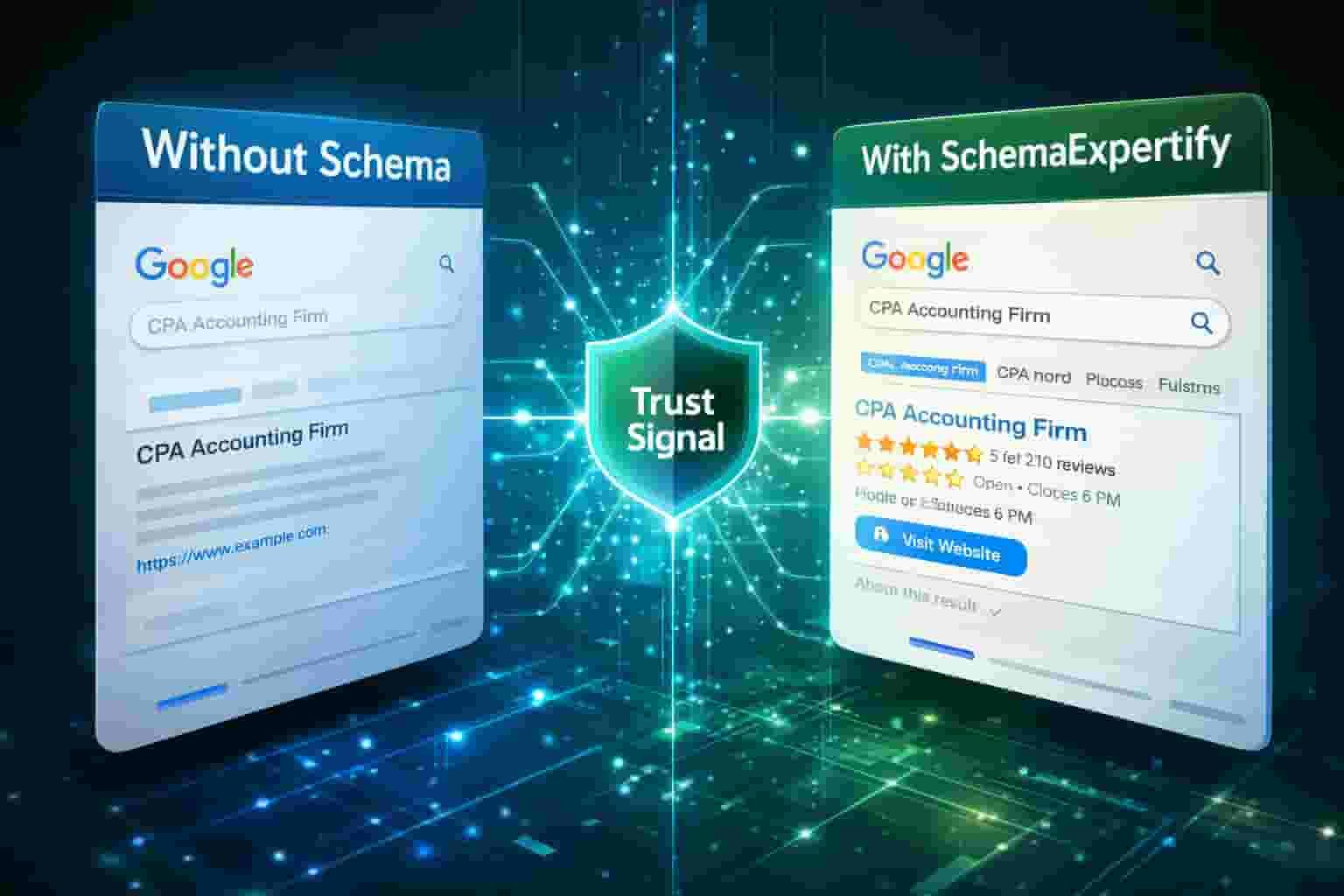
8. Common Errors & Troubleshooting: Solving the GSC Puzzle
Even with the best intentions, implementing Local Business Schema for CPA & Accounting Firms can sometimes trigger warnings in Google Search Console (GSC). The most frequent headache for accountants is the “Missing field ‘price Range'” error. While many CPAs are hesitant to list exact fees, Google requires this field to categorize your business. The fix is simple: use a price scale like $$ or $$$ to indicate your firm’s market positioning (e.g., mid-range or premium) without disclosing specific hourly rates.
Another common hurdle is the “Missing field ‘image'” warning. For a professional firm, your logo or an exterior shot of your office is vital. Ensure your JSON-LD code points to a high-resolution, crawlable image URL. If you are managing multiple locations for instance, offices in both Sydney and Melbourne or Florida and Texas do not use a single global schema. Instead, create a unique Local Business Schema for CPA & Accounting Firms for each branch. Each snippet should have its own geo-coordinates, specific telephone number, and a unique URL (ideally a location-specific landing page). This granular approach prevents “Data Cannibalization” and ensures each branch ranks in its respective local map pack.
9. The Competitive Edge in 2026
In 2026, structured data is no longer a “luxury” for tech-savvy firms; it is a fundamental requirement for survival. As AI continues to redefine how financial clients find and vet professionals, your Local Business Schema for CPA & Accounting Firms acts as your digital foundation. It bridges the gap between being just another accountant and being a Verified Authority in the eyes of Google. By following this guide, you aren’t just fixing code; you are future-proofing your firm’s growth and ensuring that when a high-value client searches for help, your name is the first one they see.