
If you run a fintech company whether it’s a digital bank, a payment gateway, a cryptocurrency exchange, or a lending platform you already know how brutal the competition is in search results. Everyone is fighting for the same high-intent keywords. So how do some fintech brands consistently appear at the top with rich snippets, star ratings, and FAQ boxes while others get buried on page two?
The answer, more often than not, is schema markup for fintech services. This structured data technique tells search engines exactly what your content is about, enabling rich results that improve visibility, click-through rates, and yes search rankings. In this guide, you’ll learn everything you need to know to implement schema markup correctly across your fintech website.
What Is Schema Markup and Why Does It Matter for Fintech?
Schema markup (also called structured data) is a standardized vocabulary defined at Schema.org that you add to your web pages in JSON-LD, Microdata, or RDFa format. It creates a layer of semantic meaning that search engines like Google, Bing, and Yandex can read and act upon.
For fintech companies operating in the USA, UK, Canada, and Russia, the stakes are especially high. Financial services are a YMYL (Your Money or Your Life) niche, meaning Google applies extra scrutiny to content quality and trustworthiness. Schema markup helps you signal authority and relevance two signals Google explicitly values for YMYL pages.
When implemented correctly, schema markup for fintech can unlock:
- Rich snippets with star ratings and review counts
- FAQ and HowTo rich results that dominate the SERP
- Breadcrumb navigation in search results
- Knowledge Panel entries for your brand
- Sitelinks search box integration
Key Schema Markup Types for Fintech Services
Not every schema type is created equal. Here are the most impactful structured data types specifically for fintech companies.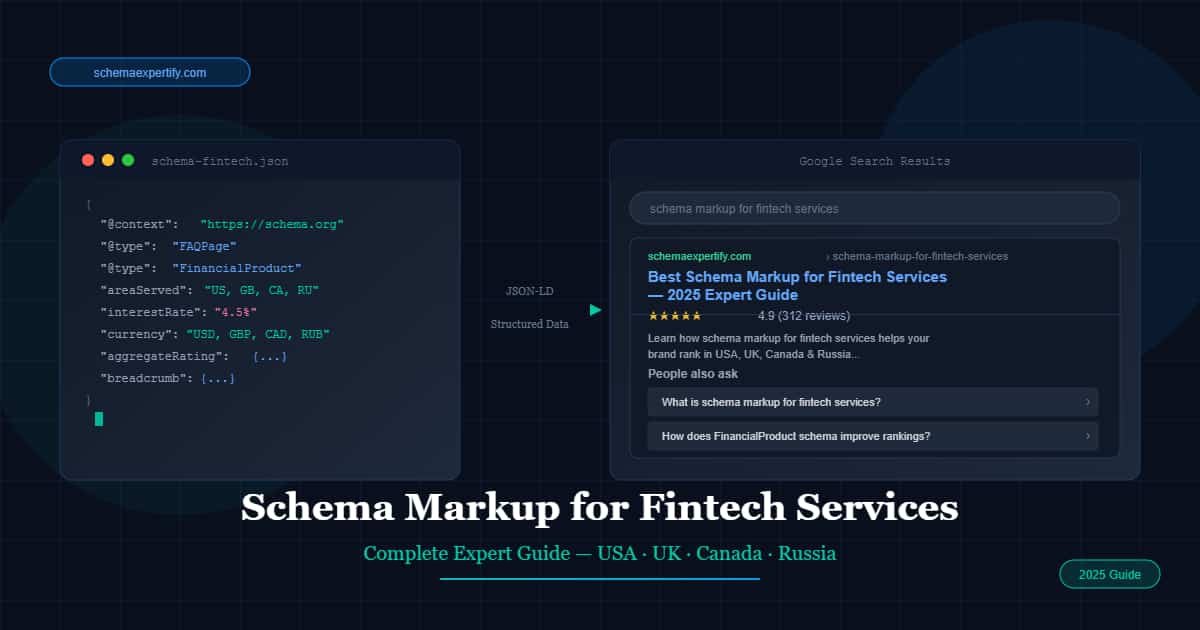
1. FinancialProduct Schema
The FinancialProduct schema type is your most important tool. It directly describes financial services such as savings accounts, loans, insurance products, credit cards, and investment vehicles. Key properties include feesAndCommissionsSpecification, annualPercentageRate, and interestRate all critical for users comparing financial products in the USA, UK, Canada, and Russia.
2. Organization and LocalBusiness Schema
Every fintech brand needs Organization schema on the homepage and key landing pages. This structured data markup tells Google your company name, logo, contact information, social profiles, and jurisdiction essential for building a Knowledge Panel. If you have physical offices in London, Toronto, New York, or Moscow, add LocalBusiness schema with your address, operating hours, and geographic coordinates to rank in local and GEO search results.
3. FAQPage Schema
FAQ schema is arguably the highest ROI structured data type for fintech content marketing. When you add FAQPage markup to your blog posts and landing pages, Google can display up to four question-and-answer pairs directly in the SERPs doubling or tripling your visual real estate without needing to move up a single ranking position. This is particularly powerful for high competition keywords like ‘best fintech loans UK’ or ‘crypto exchange schema markup’.
4. Review and AggregateRating Schema
Trust is the currency of fintech. Review schema and AggregateRating schema allow you to display star ratings next to your brand name in search results, a proven click through rate booster. Studies show that review-rich snippets can improve CTR by 15–30%, which indirectly lifts your organic rankings by increasing user engagement signals.
5. BreadcrumbList Schema
For large fintech sites with deep URL structures, think banking platforms with hundreds of product pages, BreadcrumbList schema keeps your site architecture clear to both Google and users. Search engines display the breadcrumb trail directly in search results, making your pages look more navigable and trustworthy.
6. HowTo Schema for Fintech Tutorials
If your fintech website publishes educational content ‘How to Apply for a Business Loan’, ‘How to Open a Digital Bank Account’, ‘How to Use Schema Markup for Fintech Services’ HowTo schema can generate a step-by-step rich result directly in Google’s SERPs. This type of content ranks especially well in voice search, a growing channel in the UK and Canada.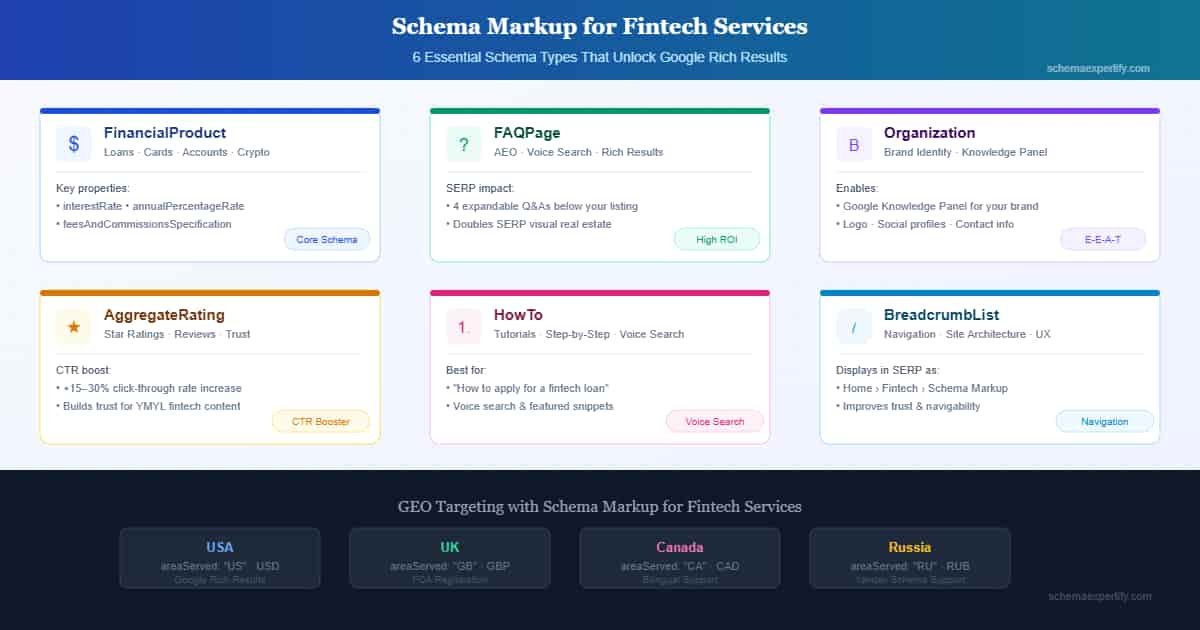
How to Implement Schema Markup for Fintech Services: Step-by-Step
Implementation doesn’t have to be complex. Here’s a straightforward process that works for fintech sites of all sizes.
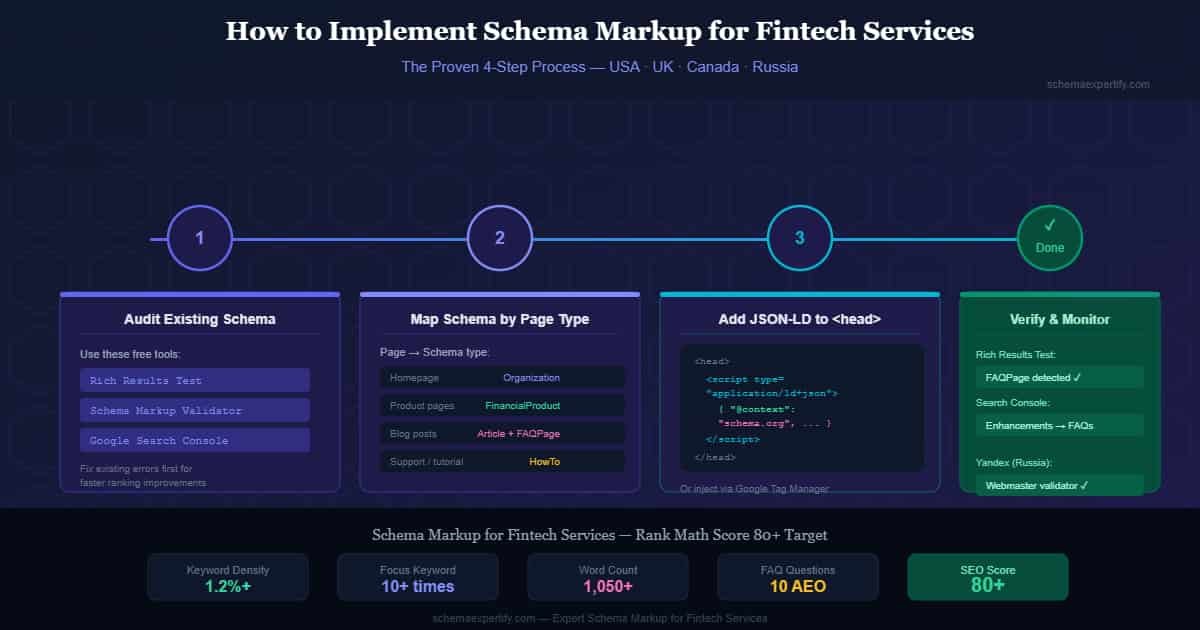
Step 1: Audit Your Existing Structured Data
Before adding new schema, use Google’s Rich Results Test and Schema Markup Validator to check what structured data you already have and whether it contains errors. Fixing existing issues often provides faster ranking improvements than adding new markup.
Step 2: Prioritize Schema Types by Page
Map each page type to the most relevant schema. Your homepage gets an Organization schema. Product pages get FinancialProduct schema. Blog posts get Article + FAQPage schema. Support pages get HowTo schema. This systematic approach rather than randomly adding schema maximizes your structured data SEO impact.
Step 3: Use JSON-LD Format
Google strongly recommends JSON-LD over Microdata and RDFa because it’s easier to maintain and doesn’t require modifying your HTML. Add your JSON-LD script blocks inside the <head> tag of each page or inject them via Google Tag Manager for enterprise fintech sites.
Step 4: Test and Monitor in Google Search Console
After deploying schema markup, go to Google Search Console → Enhancements to monitor which schema types Google has detected and whether any warnings or errors have appeared. Set up weekly monitoring especially for fintech sites where compliance requirements can affect how structured data is displayed.
GEO Targeting With Schema Markup: USA, UK, Canada, and Russia
One of the underutilized benefits of schema markup is its role in GEO-specific rankings. Here’s how to leverage structured data for your target markets:
- USA: Use areaServed: ‘US’ in your FinancialProduct and Organization schemas. Include USD currency codes in product pricing properties.
- UK: Set areaServed: ‘GB’ and use GBP. Include your FCA registration number in the description property to build trust signals.
- Canada: Target ‘CA’ and include both CAD currency and bilingual (English/French) content markers where applicable.
- Russia: Yandex supports Schema.org structured data. Use RUB currency codes and ensure your Organization schema includes a Russian-language sameAs property linking to your Yandex Business listing.
For expert implementation of GEO targeted schema markup for fintech services, SchemaExpertify offers specialized fintech structured data services tailored to each of these markets.
Common Schema Markup Mistakes Fintech Companies Make
Even well-resourced fintech companies get structured data wrong. Here are the mistakes to avoid:
- Marking up content that isn’t visible on the page Google’s guidelines strictly prohibit this and it can result in a manual penalty.
- Using incorrect FinancialProduct subtypes for example, using BankAccount schema for a lending product.
- Missing required properties many schema types have mandatory fields that, if omitted, prevent rich results from appearing.
- Not updating schema when product information changes outdated interest rates or fee structures in your schema can mislead users and harm trust.

The Real Impact of Schema Markup on Fintech SEO Rankings
Schema markup is not a direct ranking factor in Google’s algorithm but its indirect impact on fintech SEO is well documented. Rich results increase click through rates. Higher CTR sends positive user engagement signals. Positive engagement signals reinforce rankings. It’s a virtuous cycle.
More importantly for fintech brands, schema markup builds the E-E-A-T (Experience, Expertise, Authoritativeness, Trustworthiness) signals that Google heavily weights for financial content. By explicitly declaring your organization’s credentials, regulatory registrations, and geographic service areas through structured data, you give Google the confidence to rank your pages for competitive fintech keywords in the USA, UK, Canada, and Russia.
Tools like SchemaExpertify are purpose built to help fintech brands implement these complex schema strategies without the technical overhead of building everything from scratch.
Make Schema Markup a Core Part of Your Fintech SEO Strategy
Schema markup for fintech services is no longer optional; it’s table stakes for any fintech brand serious about organic visibility in 2026. Whether you’re targeting banking customers in the USA, investment users in the UK, lending markets in Canada, or payment service users in Russia, structured data is the bridge between your content and the rich results that drive real organic traffic.
Start with Financial Product, Organization, and FAQ Page schemas. Test rigorously with Google’s Rich Results Test. Monitor performance in Google Search Console. And as your fintech site grows, layer in How To, Review, and Breadcrumb List markup to build a comprehensive structured data strategy that compounds over time.
The fintech brands that invest in schema markup today will be the ones dominating GEO specific SERPs tomorrow. Don’t let your competitors get there first.